Pikey Peak vs Everest Base Camp: Which Trek Should You Choose?
Written by Lachhuman Tamang | Lead Guide & Co-founder, Moon Himalaya Adventure | Guiding in Solukhumbu since 2001
People ask me this almost every week. They have seen photos of Everest Base Camp somewhere and have it in their head as the thing to do in Nepal. Then they read about Pikey Peak, see the panorama from the summit, and start wondering whether they need to go all the way to 5,364 metres to get what they came for.
The short answer: it depends on what you actually want from the trek.
The longer answer is what this post is for. I have guided groups on both routes for over two decades. They attract different people for different reasons, and getting the choice right makes the difference between a trip you are proud of and one where you spent the last three days fighting altitude on a trail you did not enjoy.
Here is an honest comparison of the two. If you have already decided on Pikey Peak and just want the planning details, head to our complete Pikey Peak trek guide.
Quick Comparison
| Pikey Peak | Everest Base Camp |
Duration | 14 days | 14-16 days |
Max altitude | 4,065m | 5,550m (Kala Patthar) |
Difficulty | Moderate | Moderate to strenuous |
Daily walking | 5-7 hours | 5-8 hours |
Crowds | Low - often just your group | High, especially Oct-Nov |
Mountain views | Panoramic: Everest, Makalu, Kangchenjunga + 11 more | Everest and Khumbu region up close |
AMS risk | Lower (max 4,065m) | Higher (sleep at 5,000m+) |
Best for | First-timers, view-seekers, those wanting quiet | Bucket-listers, those wanting to reach the base of Everest |
Guide required | Yes | Yes |
Altitude: The Biggest Practical Difference
This is where the two treks really split apart.
Pikey Peak tops out at 4,065 metres on summit day. You sleep between 2,400 and 3,800 metres most nights. Altitude sickness (AMS) is possible above 3,000 metres, but the itinerary is paced to give your body time to adjust. Most fit trekkers who follow the schedule do not have serious problems. The Himalayan Rescue Association has good guidance on what to watch for if you want to read up before you go.
Everest Base Camp is a different story. You sleep at over 5,000 metres on several nights, and the day you walk to Base Camp itself you are at 5,364 metres. That is genuinely high. The air at that altitude has roughly half the oxygen of sea level. AMS, HACE, and HAPE are all realistic risks if you push too fast or do not listen to your body. It is not a reason to avoid EBC, but it is a reason to go in with realistic expectations about how you might feel.
If you have never trekked at altitude before and you are not sure how your body handles it, Pikey Peak is the more sensible first choice. You can always do EBC next time knowing how you respond.
Crowds: There Is No Comparison
EBC is one of the most popular treks on earth. During October and November, the trail from Namche Bazaar to Dingboche can feel less like a mountain trail and more like a slow-moving queue. That is not an exaggeration. Hundreds of trekkers are on the same path on the same days, staying in the same tea houses, looking at the same views. For some people that communal atmosphere is part of the appeal. For others it is exactly what they were trying to get away from.
Pikey Peak is quiet. On most days you will share the trail with very few other groups, and on the ridge sections approaching the summit you often have the mountains entirely to yourself. The tea houses are smaller and more personal. The villages have not changed much to accommodate tourist infrastructure.
Whether the quiet is a selling point or a drawback is a matter of taste. But it is a real and significant difference.
The Views: Different, Not Better or Worse
This question comes up a lot: do you see Everest better from Pikey Peak or from Base Camp?
They are genuinely different experiences.
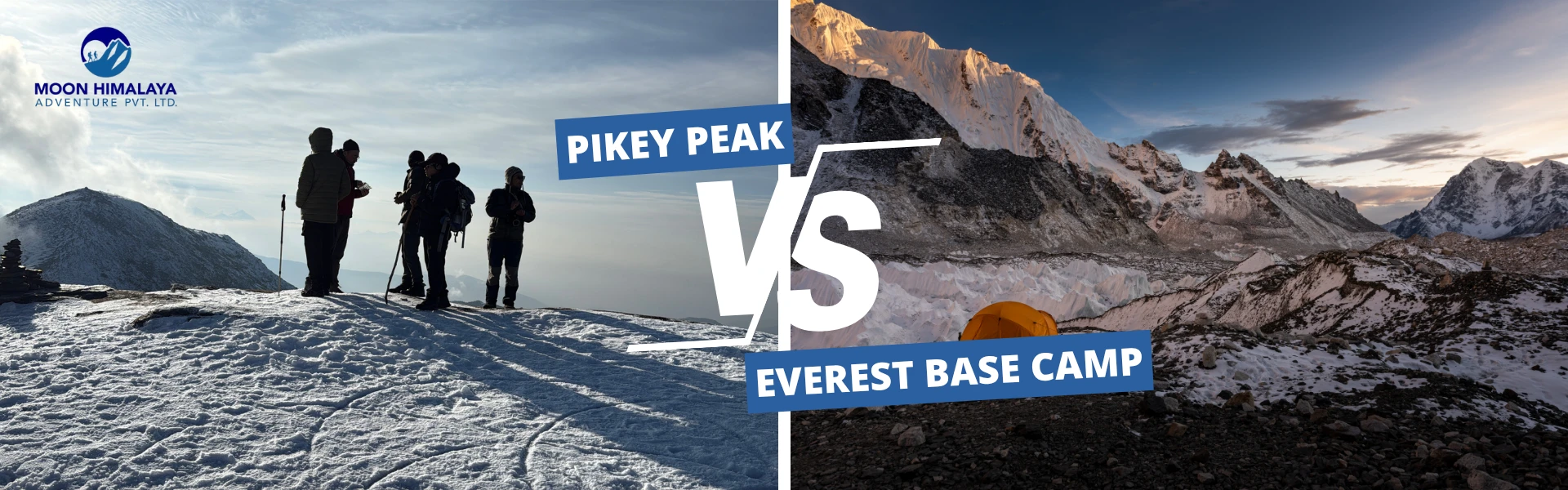
From Pikey Peak at sunrise, you are looking across the full breadth of the eastern Himalayan range from a distance. Everest, Lhotse, Makalu, Kangchenjunga, Cho Oyu and more than a dozen other named peaks are all visible at once. Edmund Hillary described this viewpoint as one of his favourites in the Himalayas after his 1953 summit. The panorama is wide, spectacular, and on a clear morning in autumn or spring, genuinely hard to forget.
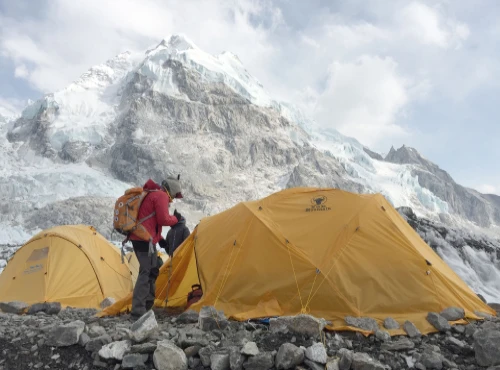
At Everest Base Camp, you are inside the Khumbu region rather than looking at it from a distance. You are close to the Khumbu Glacier, close to the route the climbing teams use in the spring season, and there is a real sense of being at the foot of something serious. Everest itself is actually partially hidden by the surrounding ridges at Base Camp. What you see is the scale and texture of the Khumbu, not a distant panorama.
Neither is objectively better. They are different things.
Difficulty and Fitness
Pikey Peak is rated moderate. You need to be comfortable walking uphill for 5-7 hours a day on uneven terrain, but there is no technical climbing, no glacier travel, and no equipment beyond standard trekking gear. A fit person with a few months of cardio preparation can complete it. The section most people underestimate is the long descent from the summit to Jhapre on Day 5 — after climbing to 4,065 metres in the dark, your legs have a lot of downhill work left before the day is done.
Everest Base Camp is also rated moderate to strenuous. The daily walking hours are similar, but the altitude adds a layer of difficulty that has nothing to do with fitness. People who are very fit sometimes struggle more with altitude than people who are less fit but more naturally acclimatised. The route also involves some rocky and sometimes icy terrain in the higher sections, and the Khumbu region trail has more elevation gain and loss than the Pikey Peak circuit.
Both treks require proper physical preparation. Neither should be attempted without building cardiovascular fitness in the months beforehand.
Duration and Getting There
Pikey Peak takes 14 days Kathmandu to Kathmandu. Most groups fly to Phaplu or Salleri (a 35-40 minute mountain flight) and return the same way. The airstrip is small and mountain flights are weather dependent, so build in a buffer day if your international connection is tight. Jeep transfer is available as an alternative if flights are cancelled.
Everest Base Camp takes 14-16 days. The classic route flies to Lukla and returns the same way. Lukla is one of the most weather-affected airstrips in Nepal and flight delays of one to two days are common, particularly outside peak season. Some groups now travel to Manthali airport and fly from there to Lukla instead, which reduces the Kathmandu airport congestion but adds road travel time.
Both routes involve mountain flights with the associated delay risk. Build that into your planning either way.
Permits
Both treks require permits, arranged in Kathmandu before departure. Your trekking agency handles this. For the current permit requirements and fees from the Nepal Tourism Board, check directly with them or ask your agency before booking as fees are updated periodically.
Pikey Peak requires three separate permits: the TIMS card, the Local Area Permit, and the Gaurishankar Conservation Area Permit. EBC requires the Sagarmatha National Park entry permit and a Khumbu Pasang Lhamu Rural Municipality permit. Note: the TIMS card that was previously required in the Everest region was discontinued in that area in 2023, but is still required for the Pikey Peak route.
Both treks require a licensed guide. Guide requirements for Nepal trekking routes were updated in 2023. The Trekking Agencies' Association of Nepal (TAAN) publishes the current rules if you want to read them directly.
Who Should Trek Pikey Peak?
- You want panoramic Himalayan views without a crowded trail
- This is your first high-altitude trek and you want to understand how your body handles altitude before committing to 5,000m+
- You have limited time and want a route that is logistically simpler
- You are interested in authentic Sherpa village culture rather than a heavily trekked tourism corridor
- You want a trek that Lachhuman specifically recommends for trekkers coming back from knee or hip injuries. The maximum altitude reduces the physiological load considerably
Who Should Trek Everest Base Camp?
- You want to stand at the foot of the world's highest mountain
- You have some altitude experience and know how your body responds above 4,000m
- The EBC tick is specifically what you came to Nepal for
- You are comfortable with the possibility of a crowded trail, especially in October and November
- You have time to build in acclimatisation days properly and buffer days for flight delays
A Note from the Trail
By Lachhuman Tamang
The trekkers who struggle most on EBC are not the unfit ones. They are the ones who decided six months ago that EBC was their goal and refused to reconsider even when their body was telling them something different on day five. Pride is the most common cause of altitude sickness I see.
Pikey Peak attracts a different type of client. They are usually people who did some research, found the route, and chose it deliberately rather than by default. Those are often the trips that go best, not because the route is easier, but because the person on it actually wanted to be there.
Both routes are worth doing. If you are genuinely unsure, I would say: do Pikey Peak first. The views are not a consolation prize. And if you want EBC afterwards, you will go knowing how your body handles altitude in Nepal.
Frequently Asked Questions
Is Pikey Peak a good alternative to Everest Base Camp?
It is not really an alternative in the sense of a substitute, it is a different trek that happens to share a region. The views from Pikey Peak include Everest and are genuinely exceptional. If what you want is a quiet, high-quality Himalayan experience with spectacular mountain panoramas, Pikey Peak delivers that on its own terms. See our full Pikey Peak trek guide for the full detail.
Can I see Everest from Pikey Peak?
Yes, clearly. From the summit at 4,065 metres you have a direct sightline to Everest along with Lhotse, Makalu, Kangchenjunga, Cho Oyu, and more than ten other named peaks. The best views are before 7am before afternoon cloud builds.
Which trek is better for beginners?
Pikey Peak is the more appropriate first high-altitude trek. The lower maximum altitude means less altitude sickness risk, and the quieter trail means you are not racing to keep up with other groups or feeling pressure to push on days when you should rest. EBC is manageable for fit beginners but carries more risk if you do not acclimatise well.
How long does each trek take?
Pikey Peak is 14 days Kathmandu to Kathmandu. Everest Base Camp is 14-16 days depending on the itinerary and how many acclimatisation days you build in.
Do I need prior trekking experience for either route?
No prior technical experience is needed for either trek. What matters is cardiovascular fitness built over months before departure, not mountaineering skills. Trekking poles are recommended for both, especially for the descent days.
Which trek has better mountain views?
Pikey Peak offers a wider panoramic view of the eastern Himalayan range from a distance. EBC gives you close-up proximity to the Khumbu Glacier and the base of Everest. Both are exceptional; they show you different things. It comes down to whether you want to see the mountains or be inside them.
Ready to Decide?
Moon Himalaya Adventure is a government-registered Nepal trekking company (Tourism Licence 3100/079) with guides who have been walking both of these routes for decades. Our group sizes are deliberately small: a maximum of 8 trekkers, and every itinerary is built around the specific group, not a fixed template.
If you are still deciding which route is right for you, get in touch with our team and we will help you work it out based on your fitness, timeline, and what you actually want from the trip.