Mount Everest is visible from Pikey Peak, but the real highlight is the wide Himalayan panorama. See which mountains you can identify, what the Everest view actually looks like, and when visibility is best.
Can You See Everest from Pikey Peak? Which Mountains Are Visible?
Table of Contents
Yes, Mount Everest is visible from Pikey Peak on a clear day. But if you expect Everest to dominate the skyline, the view may be different from what you imagine.
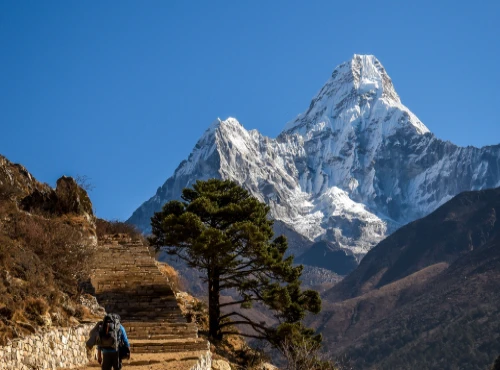
Pikey Peak lies farther south of the main Everest range, so Everest appears in the distance as part of a much wider Himalayan panorama. From the summit, you can see several mountain groups, with Everest, Lhotse, Makalu and other major peaks stretching across the horizon.
How many mountains you can see depends on cloud, haze and overall visibility. Some distant peaks may appear clearly one morning and be completely hidden the next.
Can You Really See Mount Everest from Pikey Peak?
Yes. Everest can be clearly seen from Pikey Peak when the weather is good.
The main difference is the distance.
From viewpoints deeper inside the Everest region, the mountains look much closer and larger. From Pikey Peak, you see them from farther away. Everest does not always dominate the view. Instead, it appears as part of a much wider Himalayan panorama.
That wide view is one of the main reasons people visit Pikey Peak.
Everest may also be harder to identify if you are seeing the range for the first time. Even though it is the highest mountain in the world, it does not always look much taller than the peaks around it from this angle. A guide who knows the skyline can usually point it out quickly.
If your main goal is to see Everest from as close as possible, Pikey Peak is probably not the viewpoint you are looking for. But if you want to see Everest as part of a wide Himalayan panorama, Pikey Peak offers a very different view.
Which Mountains Can You See from Pikey Peak?
Everest may be the mountain most people look for, but it is only one part of the view.
Some of the main mountains and ranges you may be able to identify from Pikey Peak include:
| Mountain / Range | What to Expect |
|---|---|
| Mount Everest | Visible on the distant northeastern skyline |
| Lhotse | Appears close to the Everest group |
| Makalu | One of the major high peaks farther east |
| Kanchenjunga | Far to the east and best seen in exceptionally clear conditions |
| Cho Oyu | May be identified as part of the wider high-Himalayan panorama in clear conditions |
| Numbur Himal | Much closer to Pikey and one of the most prominent mountain groups in the view |
| Karyolung and Khatang | Part of the nearer Solu mountain landscape |
| Gaurishankar | Visible toward the western side of the wider panorama |
| Thamserku and Mera Peak | Among the other peaks that may be identified when visibility is good |
On exceptionally clear days, the view can extend much farther across the Himalaya. Some descriptions of the Pikey Peak panorama also include very distant mountains such as Manaslu, Annapurna and Dhaulagiri.
However, you should not plan the trek expecting every distant 8,000-meter mountain to be clearly visible on the same morning.
This also explains why different sources give different answers about how many mountains can be seen from Pikey Peak. Some include peaks that may only appear in exceptional conditions, while others focus on mountains that trekkers are more likely to identify.
On a clear day, Everest, Lhotse, Makalu, Numbur and the surrounding Solu and Khumbu peaks are a more realistic picture of what you can expect to see. With better visibility, the panorama can extend much farther.
How Can You Identify Everest in the Panorama?
Finding Everest is not always as simple as looking for the tallest-looking mountain.
From Pikey Peak, Everest appears on the northeastern side of the Himalayan skyline, with Lhotse close to it from this angle. Makalu lies farther east.
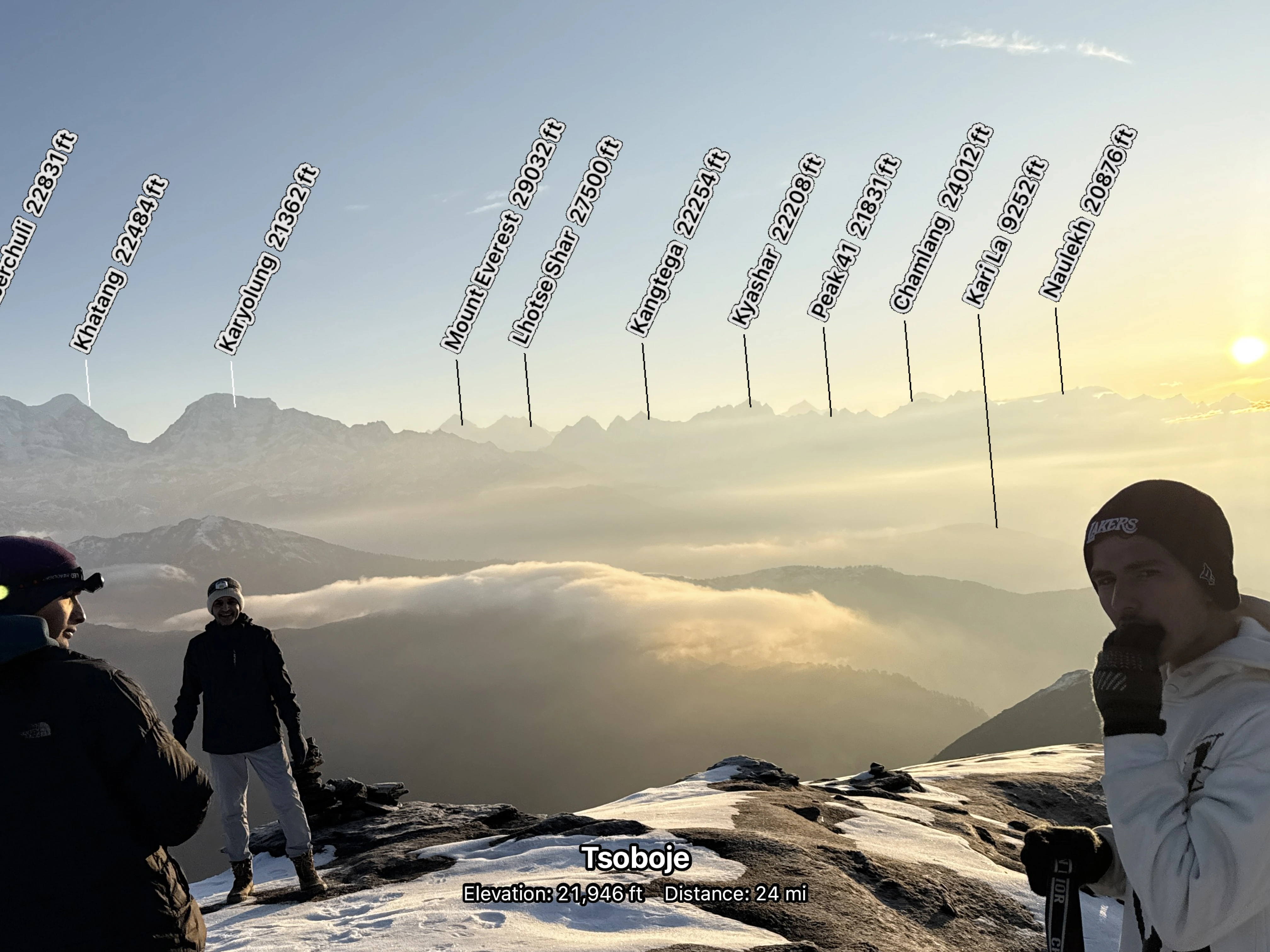
Because these mountains are far away, distance can make the skyline look flatter than you might expect. Nearby ridges and other high peaks may appear surprisingly large, while Everest can look smaller than first-time visitors expect.
This is where a guide can be helpful. Once Everest, Lhotse and Makalu are pointed out, it becomes much easier to understand where the major mountains sit across the wider panorama.
A labelled panoramic photograph can also be useful here, especially if you want to identify the peaks yourself.
Does It Matter Which Pikey Peak Viewpoint You Visit?
There are two nearby high points commonly known as Pikey Peak I and Pikey Peak II, both at around 4,065–4,068 meters.
The two viewpoints are a short walk apart and offer similar wide Himalayan views. However, moving between them slightly changes your angle across the surrounding ridges.
Most trekkers visit the viewpoint that fits their planned route. If mountain photography or identifying different peaks is important to you, it may be worth visiting both when the weather, time and trail conditions allow.
For most trekkers, however, there is no need to worry too much about choosing between them. Clear weather will make a much bigger difference to the view than the small change in viewpoint.
When Is the Himalayan View Clearest from Pikey Peak?
If seeing Everest is important to you, the time of day can be just as important as the season.
Early morning usually gives you the best chance of clear views.
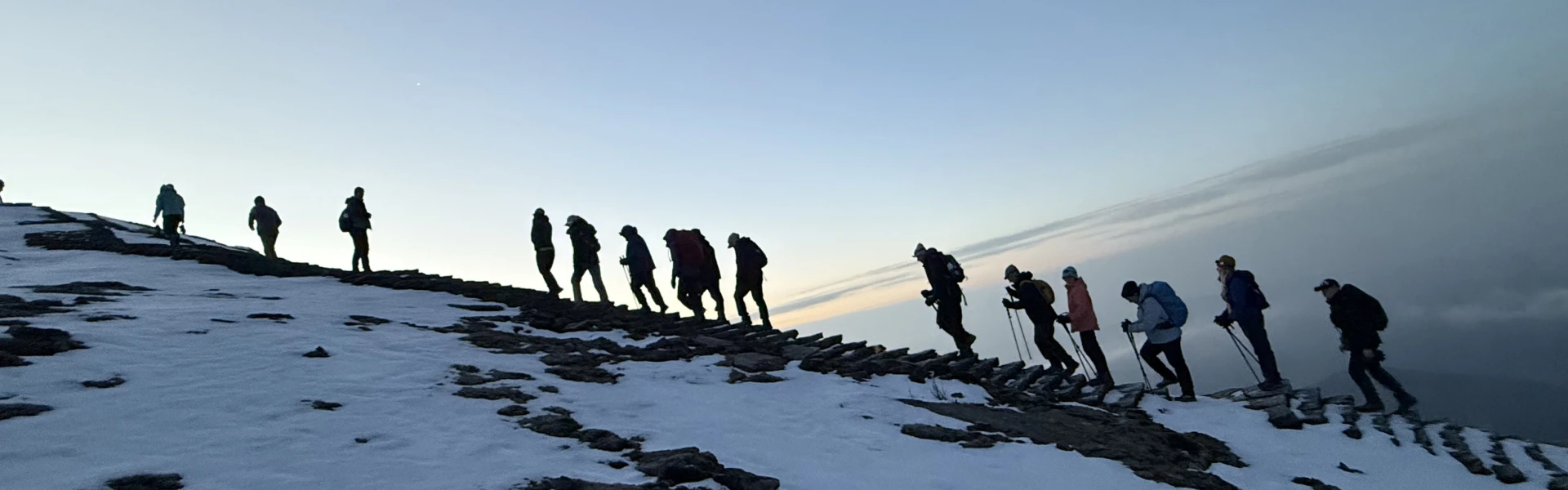
Many trekkers reach the viewpoint around sunrise, when the air is colder and the sky is often clearer. As the day warms, haze and cloud can start building around the mountains.
For long-distance mountain views:
- October and November usually offer some of the clearest conditions after the summer monsoon.
- Winter mornings can also bring exceptionally clear views, although temperatures are much colder and snow may affect the trail.
- March and April can still offer excellent mountain views, especially early in the morning, but haze can become more noticeable as spring progresses.
- During the summer monsoon, cloud often blocks much of the Himalayan skyline.
Even in the best seasons, clear mountain views are never guaranteed.
Good weather at lower elevations does not always mean the entire Himalayan horizon will be open. Thin cloud or distant haze can hide some mountains while leaving others clearly visible.
This matters even more with very distant peaks such as Kanchenjunga and the mountains farther west. The farther away a mountain is, the more clear air and good visibility matter.
On a clear morning, closer peaks such as Numbur stand out more prominently, while Everest, Lhotse, Makalu and other high mountains rise farther along the skyline. In exceptional conditions, the panorama can extend much farther east and west.
Come for the wide Himalayan panorama rather than a close-up view of Everest, and Pikey Peak makes much more sense as a viewpoint.
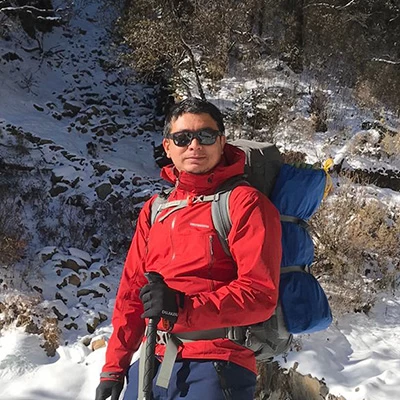
Mr. Lachhuman Tamang – A Pioneer in Trekking and Mountaineering
Call us on WhatsApp+977 9860455963OrChat with us